Talk

Why UX Writing is the Most Important Element of Narrative Design in Your Product
Ask a dozen people what UX Writing is, and you'll get a dozen different answers. It’s the text on the buttons. It’s the instructions in the tooltips. It's the clever little confirmation message that pops up after you complete a task.
And they’re all right, but they’re also all missing the forest for the trees.
We’ve spent the last decade optimizing the visual and functional components of our products to be seamless and intuitive. We A/B test the color of a button, the placement of a menu, and the speed of a transition down to the millisecond. But too often, we treat the words as the final layer of paint, a task for a "copywriter" to handle once the "real" design is done.
This is a profound strategic error. The words are not the paint. The words are the architecture.
As a storyteller who has spent my career building both fictional worlds for screenplays and user journeys for tech platforms, I've come to believe in a simple, powerful truth: UX Writing is Narrative Design. The series of words, prompts, and messages a user encounters in your product is not just a set of instructions; it is a story. It has a beginning, a middle, and an end. It has a character (the user). And it has a core conflict: the user's problem vs. your product's solution. When we treat it as such, we can transform a functional tool into an unforgettable experience.
The Three-Act Structure of a User Journey
If the user journey is a story, then it must have a structure. The most timeless narrative structure we have is the three-act structure. Let's break down how a user's interaction with a product maps perfectly onto this classic model, and how UX writing—as narrative design—guides them through it.
Act I: The Onboarding (The Ordinary World & The Inciting Incident)
The goal of Act I in a film is to introduce the protagonist, establish their ordinary world, and present them with an inciting incident that kicks off the story. The goal of onboarding is exactly the same.
- The Ordinary World: The user arrives with a pre-existing problem. They are living in a world without your solution. Great UX writing acknowledges this immediately. It doesn't lead with features; it leads with empathy for their problem.
- Bad UX Writing: "Welcome to FinTrack Pro 5.0! Our app leverages synergistic paradigms to optimize your financial workflow."
- Good Narrative Design: "Tired of managing your money in a messy spreadsheet? We get it. Let's get you set up in five minutes."
- The Inciting Incident: This is the moment the user decides to try your solution. It's the click of the "Sign Up" button. But the real narrative work is in the moments that follow. The first few screens of your app are a promise. The UX writing here must be incredibly clear, simple, and benefit-oriented. You are making a pact with the user: "Follow me, and I will solve your problem." Each step should feel like a small, easy win, building momentum.
Act II: The Engagement (Confrontation & Rising Action)
Act II is where the protagonist confronts obstacles and develops new skills to overcome them. For a user, this is the core experience of your product. They are learning your system, trying out features, and, inevitably, running into friction. The UX writing here is the voice of the mentor, guiding them through the challenges.
- Rising Action: This is where you progressively reveal your product's value. The narrative design here is about pacing and information hierarchy. You don't dump every feature on the user at once. You introduce them contextually, right when the user needs them. The writing on a tooltip or a feature discovery prompt is a line of dialogue from the mentor, saying, "You've mastered that. Now, did you know you can also do this?"
- The Midpoint (The "Magic Moment"): Every great product has a "magic moment"—the first time the user truly experiences the core value. For Dropbox, it's seeing a file magically appear on another device. For our work at Moonbeam, it was getting that first notification that another creator had viewed your profile. The narrative design leading up to this moment is critical. The UX writing must guide the user directly to this experience as efficiently as possible, and then celebrate it when it happens. A well-written confirmation message isn't just a confirmation; it's the story's first major turning point.
Act III: The Mastery (The Climax & The Resolution)
Act III is where the protagonist takes everything they've learned and uses their new skills to overcome the central conflict, arriving at a new, better normal. For a user, this is the phase where they transition from a novice to a power user. They have mastered your tool and integrated it into their life.
- The Climax (Solving the Core Problem): This is the moment the user successfully and repeatedly uses your product to solve their core problem. If your app is for invoicing, it's the moment they get paid through their first invoice. The UX writing here shifts from instructional to empowering. The messages should reinforce their success and make them feel smart and powerful.
- Good Narrative Design: "Congratulations! You've just sent your 10th invoice. You're officially a pro."
- The Resolution (A New Ordinary World): The user has now achieved their goal. Your product is a natural part of their workflow. But the story isn't over. The narrative design in this phase is about retention and advocacy. The UX writing here is about deepening the relationship. It's the check-in emails that offer advanced tips, the prompts that ask for their feedback, and the in-app messages that celebrate their milestones ("You've been using FinTrack for a year!"). This is the writing that turns a satisfied user into a loyal, long-term advocate.
Why "Voice and Tone" is Your Most Important UX Component
If the three-act structure is the plot of your user's story, then your brand's Voice and Tone is the personality of their narrator. A product with a generic, robotic, or inconsistent voice is like a story told by a boring narrator. It doesn't matter how good the plot is; the experience will fall flat.
- Voice is Consistent Personality: Is your narrator a witty, clever guide? A calm, reassuring mentor? An energetic, enthusiastic cheerleader? This should be defined in your brand guide and must remain consistent across the entire user journey.
- Tone is Situational Emotion: Tone is how that personality adapts to a specific moment.
- The Error Message: When a user hits an error, they are frustrated. This is a moment for your narrator to be incredibly clear, calm, and helpful, not witty or clever. The tone is empathetic.
- The Success Screen: When a user accomplishes a major task, they are happy. This is a moment to be celebratory and mirror their excitement. The tone is joyful.
Thinking like a narrative designer means choreographing not just the user's clicks, but their feelings. And the primary tool for choreographing feeling is the written word.
Three Actionable Steps
Shifting to a "Narrative Design" approach doesn't require you to rebuild your product from scratch. It's a change in mindset that you can start implementing today.
- Conduct a "Narrative Audit": Go through your entire user journey, from the first ad they see to the "cancel subscription" page. Take a screenshot of every single piece of copy. Print them out and lay them on a table. Read it from start to finish like a script. Does it tell a cohesive story? Is the narrator's voice consistent? Where are the plot holes?
- Appoint a "Showrunner" for Your Story: Who is ultimately responsible for the narrative consistency of your user journey? Often, the answer is "no one." The welcome email is written by Marketing, the button copy by a Designer, and the support docs by a Tech Writer. Appoint a single person or a small, cross-functional team to be the "showrunner" of your product's narrative, responsible for ensuring a single, cohesive voice across all touchpoints.
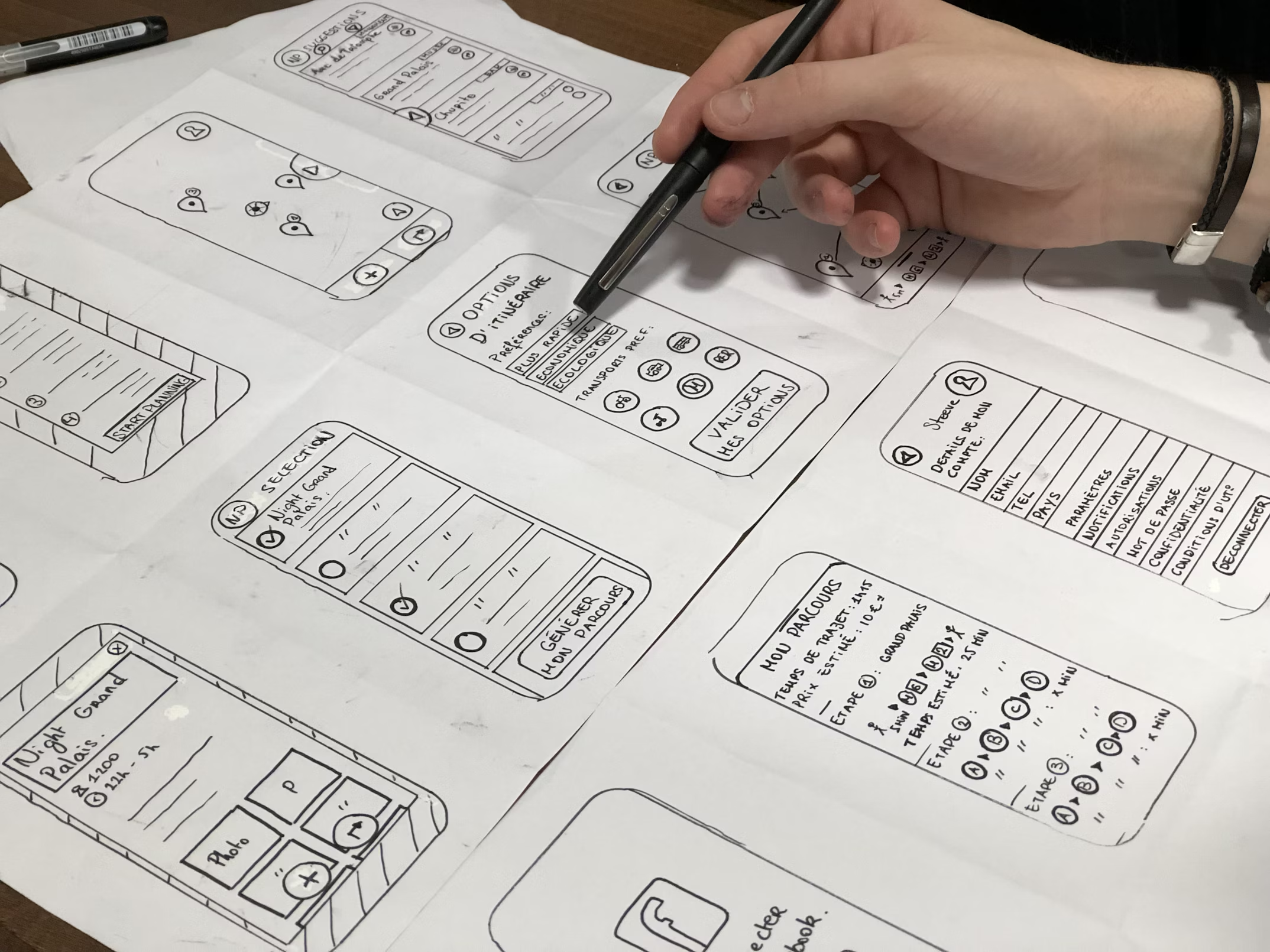
- Prototype with Words First: For your next new feature, before you open Figma, open a Google Doc. Write the user's journey as a simple, back-and-forth conversation. What does the user want? What does the app say? What does the user do next? This "conversational prototyping" forces you to nail the narrative logic before you get bogged down in visual design. If the story doesn't work in plain text, it won't work in a beautiful interface.
When we elevate UX writing from mere "copy" to the discipline of "Narrative Design," we unlock a new level of connection with our users. We build products that don't just solve problems, but tell stories. And in a world of infinite choice, the best story always wins.
Putting it into Practice
Good To Know
Bouwen jullie ook een e-commerce webshops?

Bouwen jullie alleen in Webflow of ook met andere tools?
Wat gebeurt er na de oplevering van mijn website?
Wat houdt CRO precies in en wat levert het op?
Wat zijn AI agents en hoe kunnen ze ons helpen?
Kan ik ook één onderdeel (bijv. alleen development) afnemen?
Werken jullie ook samen met interne teams of bureaus?